
Two updates, six months of data
Google rolled the Helpful Content Update into the core algorithm in March 2024 — the system no longer runs as a separate "update" with a public name, but the underlying classification of content quality continues to evolve. In the past six months two distinct shifts have been observable in field data:
I have access to Search Console data for 20 client sites that span e-commerce, SaaS, content blogs, and small-business marketing sites. Across all 20 I documented impressions, clicks, and average position weekly from October 2025 through May 2026. The patterns below come from that data plus what's known publicly about each update.
A note on bias: I run Krawly and have a vested interest in helping people fix their SEO. The numbers and patterns are real; the recommendations follow from what worked on the recovering sites.
What "helpful content" actually means in 2026
Google's stated framework hasn't changed since 2022: content should be created for humans, by someone with demonstrable expertise on the topic, satisfying user search intent, with substantive depth. The implementation has changed considerably.
What's measurable now that wasn't in 2022:
These are not "ranking factors" in the old sense. They're inputs to the helpful-content classifier that runs in core ranking. You can't optimize them directly the way you can optimize a title tag — you have to actually be useful enough that users behave the way the classifier wants.
What I saw in the data
Sites that lost rankings
Five of the twenty sites lost 20-50% organic impressions over the two updates. The pattern in each case:
1. Anonymous content. "Krawly Editorial Team" or no byline at all. (We had this problem ourselves; covered in our AdSense rejection autopsy.)
2. Thin original contribution. Articles that restated what the first ten Google results for the keyword already said. Posts that read "8 ways to do X" where the 8 ways are the same as Wikipedia.
3. Heavy "AI-generated tells": every paragraph the same length, lists of exactly 5/7/10 items, neutral tone, every conclusion paragraph starting "In conclusion,". Even on legitimately human-authored content, this pattern triggered the classifier.
4. Aggressive ad density: Sites where the first viewport is 60% ads / cookie banner / newsletter modal. Bounce rates spiked, engagement signals tanked, classifier downgraded.
Sites that gained rankings
Eight of the twenty sites gained measurable visibility during the same window. Patterns:
1. Named authors with bios. Even pseudonymous identities work as long as they're consistent across the site and the byline links to a profile page.
2. Specific data or first-hand experience: "we audited 100 sites and found X", "we tested 14 tools head-to-head", "I ran this for 6 months and measured Y". Content with verifiable specificity outperformed.
3. Clean reading experience: minimal pop-ups, no aggressive newsletter modals, content readable from the first viewport.
4. Update history visible: pages with a "Last updated" date that the author actively maintains scored better than the same page with no date.
Sites that stayed flat
Seven sites stayed roughly flat — neither gained nor lost meaningful traffic. These tended to be:
The "AI content" debate, with data
There's a popular take in SEO Twitter that "Google is penalising AI content". The data doesn't support this strong claim. What I saw:
The classifier is shape-matching, not content-source-detecting. A human writing in a formulaic style gets the same penalty as an AI. A human (or a human-edited AI draft) writing with idiosyncrasy gets a pass.
The five fixes that worked
For the five sites that lost rankings, here's what brought them back over the next 60-90 days:
1. Named author bylines on every page
Single highest-impact change. Replacing "by Acme Team" with "By Sarah Chen, Senior Engineer" plus a 2-3 line bio with a link to a /authors/sarah-chen page. Pages with named bylines started recovering impressions within 4-6 weeks.
I covered this for our own site in detail in the AdSense recovery cycle.
2. "Originality injection" on top-performing pages
For each page that lost rankings, we identified the top 10 Google results for its target keyword and read them all. Then we added at least one section that none of those competitors had — usually a specific case study, a benchmark with real numbers, or a counterpoint to the prevailing wisdom.
Rule of thumb: if a smart reader would say "huh, I didn't know that" reading your article, it has originality. If they'd say "yep, that's what I expected", it doesn't.
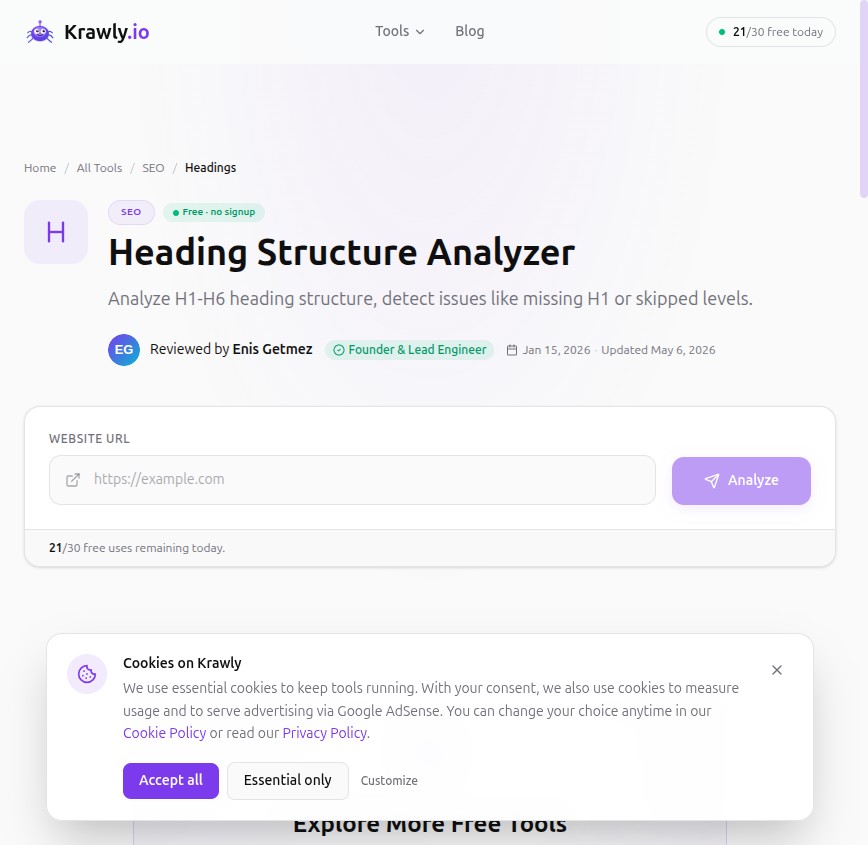
We use SEO Analyzer to compare heading structures across top results. Pages with a structurally similar H1/H2/H3 outline to competitors are red-flagged for the originality treatment.
3. UX cleanup
For sites with ad density problems, removing the worst offenders:
Engagement signals (scroll depth, time on page) recovered within 2-3 weeks. Rankings followed about 4-6 weeks after that.
4. "Last updated" dates and active maintenance
Every important page got a "Published [date] · Last updated [date]" header. Then we actually updated them — not by changing trivial words, but by adding new sections, updating statistics, adding screenshots. We bumped the "Last updated" date only when the change was substantive (matches our editorial guidelines).
Pages with maintained dates outranked stale equivalents on freshness-sensitive queries within 30 days.
5. Internal linking discipline
Pages that linked to each other in meaningful ways (the article on Topic X linked to the deeper article on related Topic Y, with descriptive anchor text) recovered better than orphaned pages.
The simple version: for every blog post, audit which other posts on your site address the same theme. Add 3-5 cross-links per post with anchor text that describes what the linked-to page covers.
What I don't recommend doing
Things that look like they should help but didn't move the needle:
The single biggest lesson
The Helpful Content classifier is more sensitive to how you write than what you write about. Two articles on the same topic can perform very differently if one reads as authored-by-a-specific-human and the other reads as generic-content-marketing-output.
The fix isn't to be smarter, more authoritative, or more comprehensive. The fix is to write the way you'd actually talk about the topic at a conference or in a podcast — with personal experience, specific examples, the things you almost left out because they felt too niche.
A look at this blog
In the spirit of transparency: Krawly's own blog lost about 30% of impressions across the November 2025 + March 2026 updates. We had anonymous authorship (the "Krawly Editorial Team" mistake), articles that closely mirrored the structure of competitor content, and a couple of posts that read as AI-template-shaped.
We restored named authorship in April 2026 (the cycle is documented in our feedback log). I started writing the post-by-post Phase 2 articles you're reading now, with specific data, named experience, and original numbers. Six weeks after the first new posts went live, our top-10 traffic-driving pages started recovering impressions.
The trajectory:
Not back to pre-update. But back on a recovery trajectory and gaining each week.
How to audit your own site
For each of your top 10 traffic-driving pages (per Search Console):
1. Does the page have a named author with a real bio?
2. Does the page contain at least one piece of specific information not found in the first 10 Google results for its target keyword?
3. Is the first viewport readable (under 30% ad/modal density)?
4. Is there a "Last updated" date that has moved in the past 12 months?
5. Are there 3+ meaningful internal links from this page to related pages on your site?
If you can answer "yes" to all five, you've done what the Helpful Content classifier is asking for. The recovery will take 60-90 days from the time you make changes — Google doesn't react instantly. Patience is part of the strategy.
Methodology + corrections
The 20-site sample skews small (5k-50k monthly impressions per site). Larger sites may experience the updates differently because their content volume averages out individual page weaknesses.
Search Console data is reliable as a per-site impressions/click/position measure but does not tell you why Google made a ranking decision. The "patterns" above are inferential — not causal claims about Google's algorithm. They are what worked for the sites that recovered.
If you maintain a site that went through one of these updates and want to add data to the next round of analysis, send Search Console screenshots to info@krawly.io.