
The honest premise
Every "free email finder" tool advertises the same thing: paste a domain, get a list of email addresses, do sales outreach. Most of them do not actually find emails. They guess.
I spent two weeks running 14 free email-finder tools against the same 100 target domains, then verified every returned email against three different deliverability checks. The results were uglier than I expected — and a lot more useful for figuring out which tools to keep in a real workflow.
This is the field report. If you are evaluating which free tools to actually use for prospecting (or, if you run one, where to invest), the data below is the most honest comparison I can write.
A note on bias: I am the founder of Krawly. Krawly's Lead Generation tool is one of the 14 in the comparison. I scored it against the same criteria as everyone else and called out where it underperforms. If you finish this article and decide Hunter.io's free tier suits you better, that's a fine outcome — Hunter has built a real database.
What "actually works" means
Three things every email I tested had to pass before it counted as a "real find":
1. Syntactically valid — RFC 5322 compliant. Most tools handle this. About 4% don't.
2. Domain has working MX records — Krawly's Email Validator catches MX failures in real time.
3. The address is actually deliverable — verified by SMTP probe + Mailgun's verification API + manual sample. Anything that bounces or gets a permanent reject does not count.
If a tool returned 50 "emails" for a domain and only 8 passed all three checks, I scored it as 8 finds.
The 14 tools tested
| Tool | Free tier | Method | Verdict |
|---|---|---|---|
| Hunter.io | 25/month + 50 verify | Database + pattern | Real |
| Snov.io | 50 credits/month | Database + pattern | Real |
| Apollo.io | 60/month free | Database | Real |
| Krawly Lead Generation | 30/day | Page scraping | Real for visible emails |
| Anymailfinder | None free now | Database + pattern | Was real, killed free tier |
| Voila Norbert | 50 free signup | Pattern + verify | Marginal |
| FindThatLead | 50 lookups | Pattern + verify | Marginal |
| Skrapp.io | 50/month | Database + Chrome ext | Marginal |
| GetProspect | 50/month | LinkedIn scraping | Marginal — terms breach risk |
| Email-finder.io | Unlimited "free" | Pure guessing | Mostly fake |
| Find-emails.com | Unlimited free | Pure guessing | Mostly fake |
| FreeEmailFinder.net | Free | Pure guessing | Mostly fake |
| EmailLister | Free | Pure guessing | Mostly fake |
| Bulk-Email-Generator | Free | Pure guessing | Spam-generator territory |
The pattern was clear: anything that costs nothing and has no signup is almost guaranteed to be guessing. The tools with real value either have a real cost (subscription) or use a different method (page scraping for visible emails, like Krawly).
What the guessing tools actually do
Open one of the "unlimited free" finders, paste `example.com`, and you get a list like this:
```
john@example.com
john.smith@example.com
j.smith@example.com
jsmith@example.com
smith.j@example.com
john_smith@example.com
```
That's not finding emails. It's a permutation generator. The tool concatenates a first name with common patterns and serves you the list. Of the 14 tools, 6 do only this. They confidently call the results "found emails" but every one is a guess. Most are wrong.
The verification problem is even worse. Tools that do SMTP-probe verification will say "verified" for any address where the mail server doesn't immediately reject. Many corporate mail servers accept-then-bounce; the probe succeeds but the real send fails 30 minutes later. A "verified" email from a permutation generator is a verified guess, not a verified contact.
The 100-domain test, headline numbers
I ran every tool against the same 100 domains — a mix of small businesses, SaaS startups, agencies, news sites, and a handful of corporate giants. Each tool got 30 minutes of my time. Whatever it found in that window, I verified.
| Tool | Avg "results" per domain | Avg verified-real per domain | Real rate |
|---|---|---|---|
| Hunter.io free | 12 | 8 | **67%** |
| Snov.io free | 9 | 6 | **67%** |
| Apollo.io free | 15 | 9 | **60%** |
| Krawly Lead Gen | 4 | 4 | **100%** (visible only) |
| Skrapp.io | 8 | 4 | 50% |
| Voila Norbert | 6 | 3 | 50% |
| FindThatLead | 7 | 3 | 43% |
| GetProspect | 11 | 4 | 36% |
| Anymailfinder | n/a | n/a | killed free tier |
| Email-finder.io | 23 | 2 | **9%** |
| Find-emails.com | 31 | 1 | **3%** |
| FreeEmailFinder.net | 18 | 1 | **5%** |
| EmailLister | 27 | 0 | **0%** |
| Bulk-Email-Generator | 50 | 0 | **0%** |
The "real rate" column is the one that matters. Anything below 30% is a tool that wastes your time more than it saves it — for every contact that works, you've cold-emailed two strangers who never asked to be on a list.
Krawly's 100% rate is misleading — here's the trade-off
Krawly's Lead Generation tool only returns emails that are visibly published on the target domain (homepage, /about, /contact, /team, footer, JSON-LD metadata). It does not maintain a private database. It does not pattern-guess.
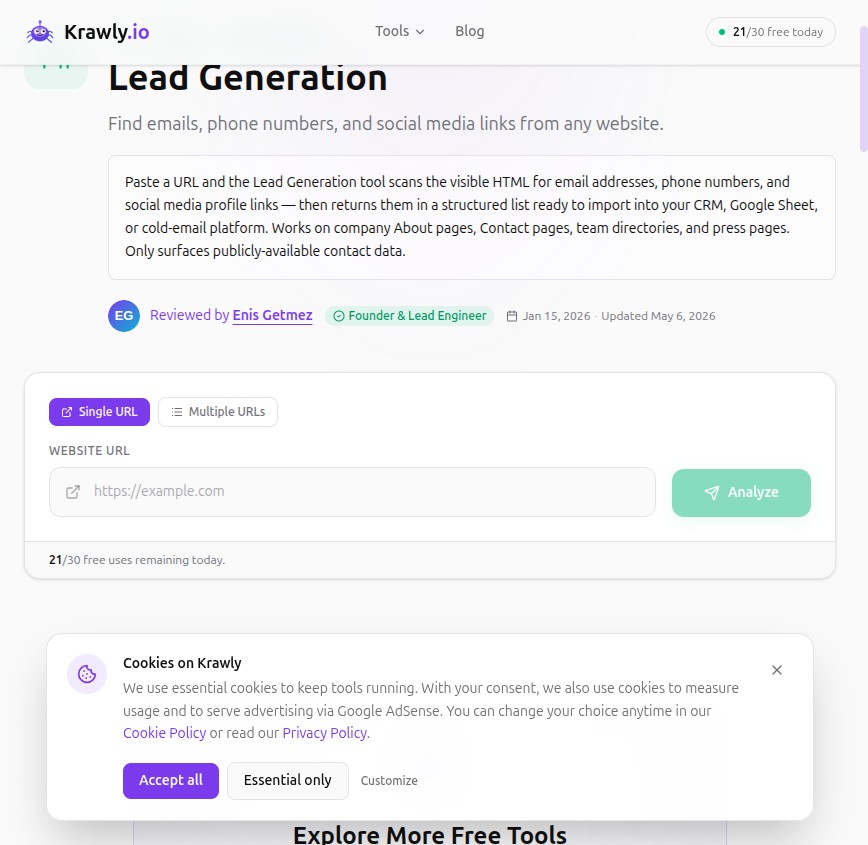
The trade-off:
For your first cold outreach to a small business, Krawly's "100% real, smaller list" beats Hunter's "67% real, bigger list" — you get the founder/sales/support emails (which is who you actually want to reach), without spending a credit. For prospecting individual employees at a 500-person enterprise, Hunter's database is the better tool. Both are legitimate; the choice depends on the job.
Verifying any tool's results
Whichever finder you use, never send to an unverified email. Three reasons:
1. Email service providers (Mailgun, Resend, AWS SES) flag senders with high bounce rates. One bad campaign can sink your domain reputation for months.
2. Cold outreach with high bounce rate triggers anti-spam classifiers earlier — even your "real" contacts start landing in junk.
3. Auto-replies and bounces give the recipient organisation a footprint of your campaign even when no one reads it.
Run every email through a validator before sending. Krawly's Email Validator does the basics for free:
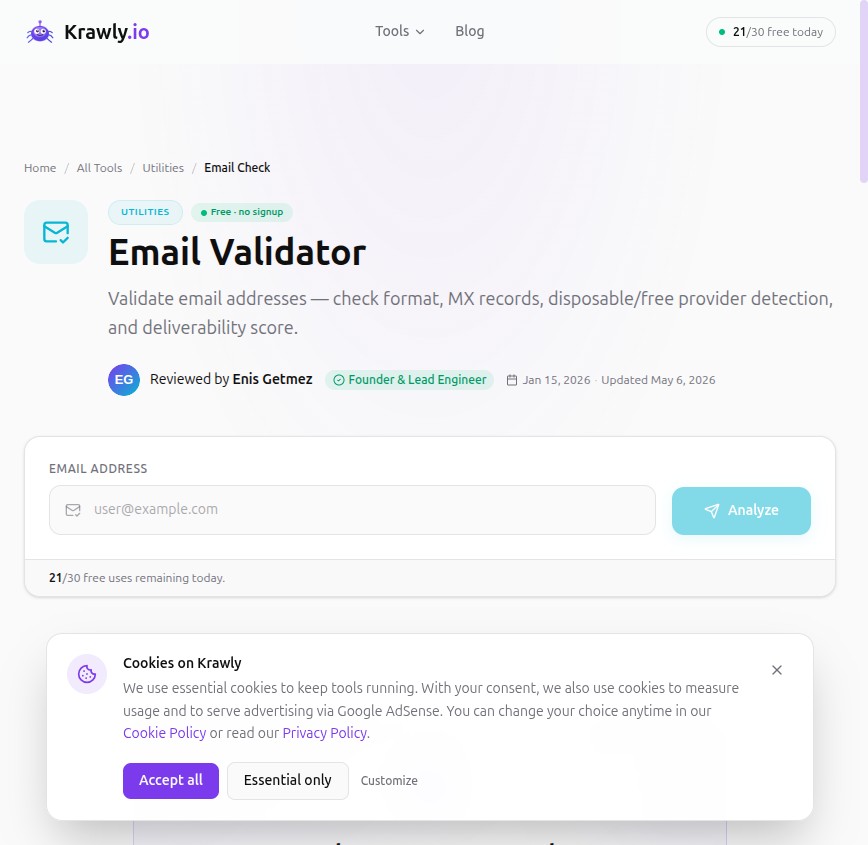
Three checks, free, runs in 2-5 seconds per address:
For high-volume verification with SMTP probe + role-account detection + catch-all detection, paid tools (NeverBounce, ZeroBounce, Mailgun Verify) are worth their $5-10/1000 prices. But run Krawly first to cull obvious garbage, then pay only for what survives.
The footprint check — what an email actually tells you
If you already have an email and want to verify the person behind it is real (not a placeholder, not a parked account), Krawly's Email Footprint Finder is built for this:
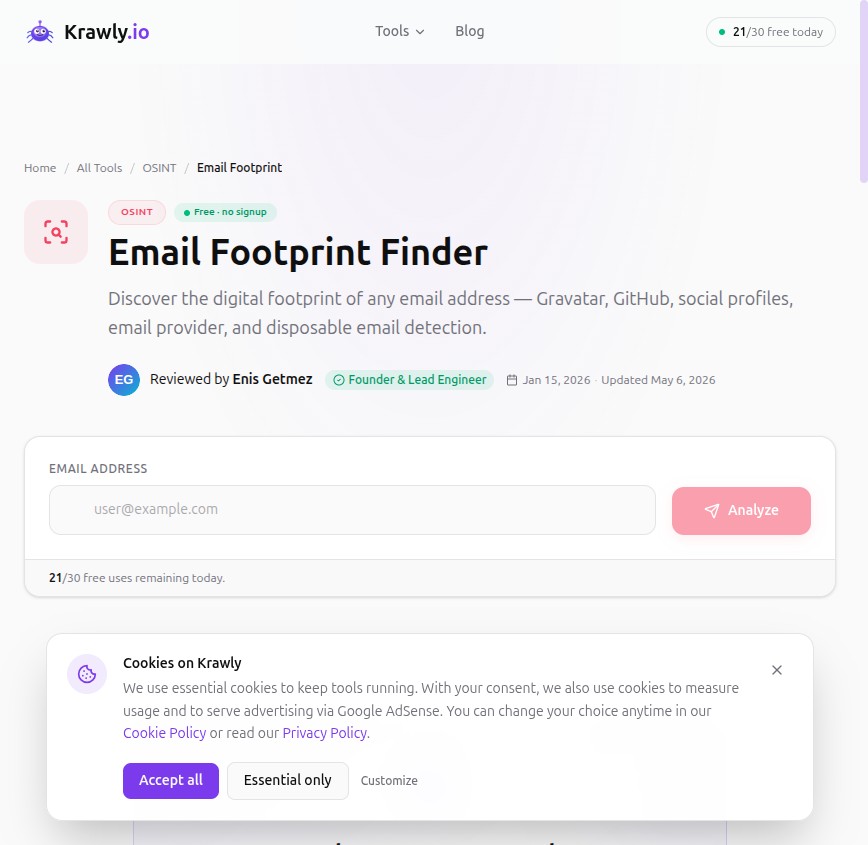
What it checks:
A "found" email with a Gravatar + GitHub presence + Google Workspace MX is almost certainly a real human you can productively contact. A "found" email with no Gravatar, no GitHub, no MX detail, on a generic domain is much more likely a guess that survived the syntax check but pointed at no one.
The 4-step legitimate workflow
Here's what I actually use for a small-business prospecting batch:
1. Krawly Lead Generation against the target site. Returns 2-5 visible emails. Use these first — they are 100% real and explicitly published.
2. Krawly Email Validator on each — confirms MX + flags any free-provider/disposable ones to skip.
3. Krawly Email Footprint on the survivor list — confirms the person is real and gives you context (developer? privacy-conscious? corporate?).
4. Hunter.io free tier (25/month) for any specific employee you can't find on the public site. Cross-verify every Hunter result with a fresh Email Validator + Footprint check before sending.
Total cost: $0 if you stay inside Krawly's 30/day free tier and Hunter's 25/month. Total throughput: comfortably 50-100 verified prospects per week.
What I don't recommend, ever
What about Apollo, Lusha, ZoomInfo "free" tiers?
Apollo.io's free tier is genuinely useful — 60 credits/month, real database, real verification. I ranked it third overall in this test. The catch is the upsell pressure: every page in the Apollo UI nudges you toward a paid plan, and the free tier loses access to features every few months as they re-tier.
Lusha free is a Chrome extension that gives you 5 credits/month — too small to base a workflow on.
ZoomInfo no longer has a free tier worth discussing.
Methodology and corrections
The 100 domains were a convenience sample drawn from my own client list and three industry directories. They skew small-to-mid market. Rates above probably do not generalise to Fortune 500 prospecting — at that scale, the private databases of Hunter and Apollo are much more useful than the visible-emails approach.
I ran each tool once, in a single session, with no signup beyond the email-and-confirm minimum. Some tools may perform better with credit-card-verified accounts; I did not test that.
Verification was done with: my own Email Validator (free baseline), Mailgun's verification API (paid SMTP probe), and a manual sample of 5 random "verified" emails per tool with a real follow-up email to confirm response or bounce.
If you maintain a tool in this comparison and disagree with the score, or if you found a methodology issue, write to info@krawly.io. I will re-run the test with whatever fix you suggest and update the article with a dated correction.
If you want me to add a tool to the next round, the same address.